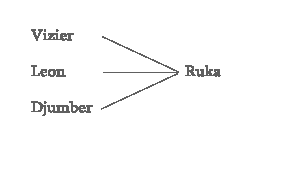
It should be pointed out that there is a too important and interesting compositional detail in the discussion at end of "Wisdom of Fiction" by Sulkhan-Saba Orbeliani. This discussion is held among Ruka and Vizir-Leon-Djumber after the shame of eunuch [1]. Sulkhan-Saba Orbeliani determines strictly the order of the participants of discussion, in which a reader will assure easily if he follows the alternation of the reciters of the fable:
- Vizier - Ruka
- Leon - Ruka
- Djumber - Ruka
- Leon - Ruka
Such alternation of the reciters repeats four times [1] and it should have a distinct compositional meaning [2] for sure in the represent rhythmical scheme. It is obvious that the author apparently from this point of view mentions a reader about the evidently reflected contrast among Ruka and the other characters:
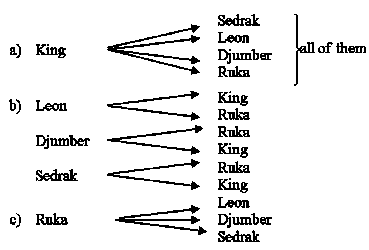
The analysis which foresees the distribution of the fables on the characters gives the important supplementary arguments. Each fable naturally has a reciter as well as an addressee that is the person who the reciter applies to.
From 152 fables of "Wisdom of Fiction":
Such distribution shows that Leon's character has the most artistic function in the work - he is an expresser of the author's opinion as well as a transferor and the main reciter of the author's minds.
From this point view Ruka take the place after Leon. Ruka is Leon's enemy; he is a competitor of work and word of Leon. It should be noted that exactly Leon-Ruka's couple, and not Sedrak-Ruka's, makes a real opposition in "Wisdom of Fiction" [3: 125; 4]. As the analysis of the work shows this couple (Leon-Ruka's) is the face of two incompatible fable types, They have neither hostile nor fighting interrelation each other. In "Wisdom of Fiction" the combat for the choice of the style of king's life essentially realized with the artistic-parable faces of Leon and Ruka (and not of Sedrak and Ruka).
Though Leon is not alone in this combat. There are Djumber, Sedrak and king Finez with him too. Majority from the fables of Leon, Djumber and Sedrak has Ruka and king as the addressees. Mostly Leon, Djumber and Sedrak address Ruka with the fables or tell them the others because of Ruka to understand them. With the fables about the carelessness and magicians Leon pays attention toward the king, who is Djumber's father and the king of the country. It is naturally for a spiritual tutor on the one hand to be submissive of his owner for his charity and protection forever and the other hand it should be harmony and adherent between the spiritual and corporal fathers to have a normal upbringing process.
It is obvious that Ruka's fables are distributed almost equally for these three characters; only they are the addressees of the eunuch's fables. Ruka tells the king just three fables and they deal with Leon.
The analysis of distribution of the fables proves and confirms once more the opposition which we have among Leon-Djumber-Sedrak and Ruka, the reciters of the fables.
As for king Fines, his fables are distributed equally for the other for characters: as a rule king's word and attention are for all of them.
As is seen we have the following scheme of distribution of the fables with foresight of the reciters and their addresses of these fables:
Here I should like to note one more moment.
Vizier's and Leon's fable contact is minimized in the work: Leon tells only one fable for Sedrak - "King of India and the viziers" [1], but the vizier has not Leon as addressees even once. Djumber's contact with Leon and Sedrak which has the same fable meaning is reduced to zero: we have not met Leon, vizier and Sedrak as the addressees of prince's fables. Sulkhan-Saba Orbeliani made prince to tell the fables only for Ruka and king Finez.
Above mentioned alternation of the reciters (4-times repetition0 of the fable was ceased by the king's will. Sulkhan-Saba Orbeliani mentions:
"The king overheard: at times he laughed, at others he was pleased, at times he got angry and was loveless for them and finally it was clear he was wickedly for Ruka"[1].
The king had an attempt to calm this unlimited discussion by the fable "The dogs and a wolf" ("The quarrelsome dogs"). From the participants of this discussion only the vizier dared to justify himself before the king.
King Finez's words are the final advice that follows the fable of "The duck and the frog":
"As for Ruka, he is doing only the evil things, don't take after him; do only the good things" [1].
This is a main binding advice of the work. The author made Djumber-Leon-Sedrak-Finez to tell us this main advice, cf.:
Prince: "The great kindness of men is not to remember the evil things, but answer them with kindness again" [1].
Leon: "God does not forget goodness of man" [1],
"Nobody will do the evils for kindness of man... a great and a little equally have a good answer for kindness" [1].
Sedrak: "A man should not be malicious and a reciter of the evil things; he should show loveliness to everyone" [1].
King Finez: "The viziers should love each others. If a vizier is a faithful of his king, he will make his enemy as a friend, forgive him his wickedness; they will have to join and this will be the only real ground for their king to prove his reigning" [1].
"Do virtue" [1].
Finally it is obvious the main motive of polarization of fable-characters of "Wisdom of Fiction" - it is an incompatibility of kindness and evil, wisdom and wickedness, sin and boon, loveliness and hostility, honour and disgrace, satisfaction and insatiability, modesty and haughtily [5: 226-265].
Sulkhan-Saba Orbeliani makes dilemma for his reader and tells him:
The way of wicked eunuch - is equally inadmissible for the god and the men.
And the way of Finez-Sedrak-Leon-Djumber - is divine, dressed with Christian light and steady with unity.
Do the right choice, but in time and vigilantly!
Birth, upbringing and exercise of prince proves the author's choice and teaches us, that the healthy spiritualness, bound with unity, is Christian by its being, contents and aspiration.
With his great work Sulkhan-Saba Orbeliani agrees Saint David who writes in his psalm: "How very good end pleasant it is when kindred live together in unit" (psalm. 132, 1).
"Sterile" soul and nature will never conquer such unity [5], as the light shines in the darkness and the darkness did not overcome it (John 1, 4-5).
"Today it is enough for us to say so much" [1].
We would also say like this at the end of the previous analysis.